
Act 3 Mini Essay:
Choosing between gold, silver and lead for the hand of a woman in marriage is certainly a weird way for Portia’s father to decide who would decide her husband. However, for the purposes of a dramatic story like Merchant of Venice, it’s the perfect plot device. Men from all over the world came to see Portia, but to no avail. In the end, true love triumphs and the one man that Portia actually wants to marry chooses the correct casket.
The Prince of Morocco chose the glowing prospects of the golden chest, which bore the note saying it contained “what many men desire”. This ended up being the incorrect choice because the prince essentially reasoned that Portia was, in fact, the thing that many men desire. The reason he was wrong was because Portia’s dad didn’t want his daughter’s groom to be superficial and only take outward appearance into account.
Next, the Prince of Arragon decided to see “what he deserves” from the silver chest. In his arrogance, he assumes that he deserves the very best and boldly throws open the lid of this chest. Unfortunately for him, he was only greeted with the knowledge that he’s an idiot. Again, it shows the flaws in the person just by what he chooses because he thinks he deserves Portia.
However, when Bassiano comes to take his pick of the boxes, Portia tells him to delay his choice just a bit, for she’s worried he might choose wrong like the previous two suitors and they won’t be allowed to spend time together anymore. But he chooses correctly, because like the inscription says, he gave up everything for a chance to be with Portia, his true love. It shows that he was humble and didn’t ask for much, while also taking risks for the sake of love.
Interpretive Art Poster:
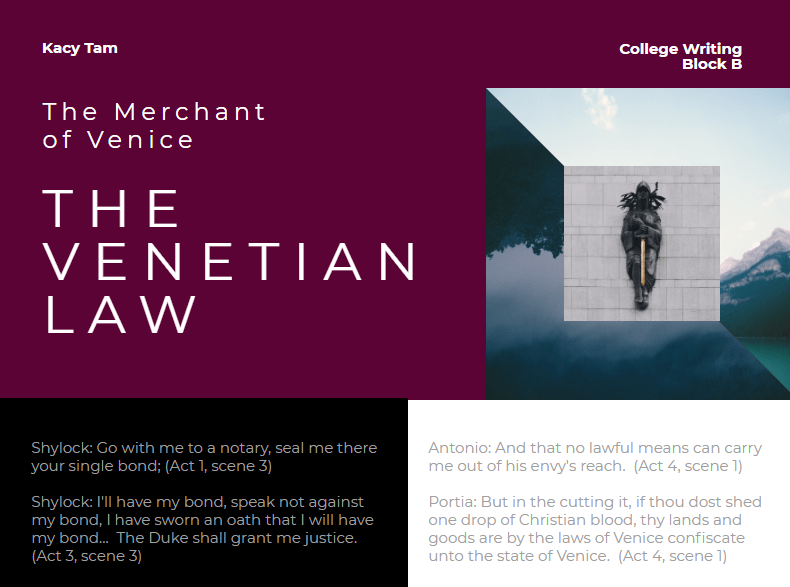
Reflection:
This play was a fun one to read, especially near the end when Portia saved Antonio’s life with her wit. The mini essay here was a reaction and analysis of the third act in the Merchant of Venice. Something that I didn’t really point out in this piece because it didn’t fit in was how odd the whole situation was. Firstly, that supposedly many suitors came to try their luck and apparently all of them chose incorrectly even though there’s about a 33% chance they could choose right if it were random. But beyond that, I thought it was so archaic that Portia was viewed as the prize in this situation. I don’t really think that this was a product of it’s time, because we see that Portia can, in fact, hold her own very well so I thought this view of women was weird within the play itself. Though I guess the ending does serve as poetic justice of some sort because she proves to everyone that she was the mastermind behind the saving of a man’s life.
Then for the interpretive art poster, I tried to explain the idea of the law in the story with my icon. I put a statue with a sword in between two scenes, one dark and one light. To me, this shows the role that the law plays in keeping balance between the two sides of morality. I also backed these up with quotes from the play where the characters were using the law for both good and evil. I enjoyed putting together the icon because I was trying to find an interesting way to show the dual nature of the law in this play. Also, the dark scene is upside down because of a happy accident with formatting that I decided to keep in because it shows just how opposite the two ideas are but that they can still be connected with one idea.
 Kacy Tam - College Writing